

St. Augustine is the most quoted Saint in the Catechism of the Catholic Church with 87 Citations followed by St. Thomas Aquinas at 61. Naturally, in many respects, as asserted by Bishop Robert Barron asserts in his Pivotal Players series, St. Augustine is “one of three or four most important players in the history of the Church…he is a pivotal figure in the development of Western Civilization. He is the most significant bridge of ancient Rome and the Christian culture that would come to full flower in the Middle Ages. As a master of the Latin language; he ranks with Cicero, Virgil and Ovid. As a theologian and philosopher, he has practically no rivals, with the possible exception of Thomas Aquinas.”[1]
Augustine was born to St. Monica in Thagaste in North Africa which is now modern-day Algeria in 354 A.D. St. Monica, a devout Christian and his father a pagan by the name of Patricius. Augustine had a difficult relationship with his father, who enjoyed drinking and was a little rough. Patricius would later convert to the Christian faith on his death bed. During Augustine’s youth, his father paid for him to be tutored in Carthage, where not long after that in 370 A.D. Augustine would father a son to a woman he does not name in the Confessions. It was shortly after this period that Augustine becomes interested in philosophy by reading Ciceroes Horetensius, which unfortunately has been lost to history. What we know of this document, we know only from sources like Augustine who quote the document. Augustine would teach and later become the rhetorician of the Emperor of Rome in Milan. He also becomes involved with a heretical group called the Manicheans which practiced a quasi-Christian dualistic world. It combined Neo-Platonic elements of light, darkness, good, evil within some elements of Christian Gnosticism. A good source for an explanation of Manichean belief is Classics scholar Robin Lane Fox’s massive volume titled Augustine.
It is after St. Augustine hears the preaching of St. Ambrose, the Bishop of Milan, that he is converted to Christianity. St. Ambrose introduces him to a synthesis of Neo-Platonic thought into orthodox Christianity, Augustine quits his job with the emperor and baptized on Easter in 387 A.D.
It’s fairly easy to intimately know St. Augustine conversion story. Augustine wrote one of, if not, the first autobiographies in Western Civilization—still readily available in print to this very day. Augustine’s Confessionsis unique as it gives a person account of his youth, sinful character, conversion, and foundational theology and philosophy. It is in the pages of theConfessions we learn that Augustine could not find peace in glory, power, wealth, and pleasure. He finally finds peace in a submission of his will to a crucified mocked, beaten, poor, and suffering Jesus Christ. Augustine writes in the first page of the Confessions, “Our Heart is restless until it rests in thee.”[2]A position of submission, a position quite strange to our 21stcentury Western world that values rights over duties and expressed individualism over the social good. Fr. Jacques Philippe in his book Interior Freedom gives a clear diagnosis of our current cultural climate writing, “that our love often goes in the wrong direction: we love ourselves, selfishly, and end up frustrated, because only genuine love can fulfill us.”[3]St. Augustine reminds us, as we will see with his multiple works, that many issues we may consider to be a development of modern society are very old issues simply recycled.
The first time I came to be acquainted with St. Augustine is the beginning of 2008. At the time I was attending the University of Illinois Chicago. I needed to take an elective class, I looked at the class catalog—they still had those at the time—and saw that there was a course offered on “Catholic Thought.” I thought to myself, “Hey, I’m Catholic, this is an easy “A.” Of course, what I found out is that the professor is considered a serious scholar on Augustinian topics and he went by the name of Paul J. Griffiths. Now, I had gone to Catholic School K-8 and confirmed in the Catholic Church but it was a secular university where I learned that Catholicism is a serious intellectual powerhouse built on Divine Revelation, Apostolic tradition, and serious intellectual prowess. It was at the University of Illinois at Chicago, I learned that Catholicism is smart, a seed of admiration for St. Augustine was planted.
The course, being a survey course, we only dived into selected material of St. Augustine’s Confessions.It is in those pages where Augustine begins to develop the theology of Original Sin. It’s an interesting process to ponder that the Church operated under the idea of Original Sin for approximately four centuries as it formulated the purpose of the second person of the Trinity in its Nicene Creed, but it was Augustine that developed it into a theological language known to us now as “Original Sin.” The most famous passage in the Confessions that deals with this particular topic is when Augustine examines his motives for stealing pears as a young boy.
Augustine writes:
Surely, Lord, your law punishes theft, as does that law written on the hearts of men, which not even iniquity itself blots out. What thief puts up with another thief with a calm mind? Not even a rich thief will pardon one who steals from him because of want. But I willed to commit theft, and I did so, not because I was driven to it by any need…For I stole a thing which I had plenty of my own and of much better quality. Nor did I wish to enjoy that thing which I desired to gain by theft, but rather to enjoy the actual theft and the sin of theft.
…We took great loads of fruit from it (orchard), not for our own eating, but rather to throw it to the pigs;
…Behold, now let my heart tell you what it looked for there, that I should be evil without purpose and there should be no cause for my evil but evil itself. Foul was the evil, and I loved it[4].
After reading this selected material, we were asked in a lecture by Professor Griffiths, what is the source of our desire to do evil? Augustine explains that the sin we desire to commit is caused by a weakness or wound to our hypomorphic nature (body and rational soul composite). Augustine explains that it was in humanity’s disobedience to God that deprived us of our original grace or friendship with Him and it affects even the littlest of us. As all that God creates is good in form, evil and sin is a deprivation of the good. For example, if someone wishes to do good for someone; they will what it means as the perfection of another. If someone wishes to do harm; they will deprive them of the good or perfection.
Naturally, a lot of this development of the idea Original Sin is further solidified in Augustine’s debate with Pelagius and Pelagianism. Pelagianism is an early Church heresy that argued that people could attain salvation by good works, or basically if you’re a good person you go to heaven. Many in our modern Catholic Church would find it shocking that the Church has never taught that being good is all one needs to go to heaven. Pope Francis warns us of Neo Pelagianism in his Apostolic Exhortation GAUDETE ET EXSULTATE:
49. Those who yield to this pelagian or semi-pelagian mindset, even though they speak warmly of God’s grace, “ultimately trust only in their own powers and feel superior to others because they observe certain rules or remain intransigently faithful to a particular Catholic style.”
52. The Church has repeatedly taught that we are justified not by our own works or efforts, but by the grace of the Lord, who always takes the initiative. The Fathers of the Church, even before Saint Augustine, clearly expressed this fundamental belief. Saint John Chrysostom said that God pours into us the very source of all his gifts even before we enter into battle.[53] Saint Basil the Great remarked that the faithful glory in God alone, for “they realize that they lack true justice and are justified only through faith in Christ”.[54]
The Second Synod of Orange taught with firm authority that nothing human can demand, merit or buy the gift of divine grace, and that all cooperation with it is a prior gift of that same grace: “Even the desire to be cleansed comes about in us through the outpouring and working of the Holy Spirit”.[55]Subsequently, the Council of Trent, while emphasizing the importance of our cooperation for spiritual growth, reaffirmed that dogmatic teaching: “We are said to be justified gratuitously because nothing that precedes justification, neither faith nor works, merits the grace of justification; for ‘if it is by grace, it is no longer on the basis of works; otherwise, grace would no longer be grace’ (Rom 11:6)”[5]
Ultimately, it is through Augustine’s observation of life that he concludes through reason that we’ve been scarred by Original Sin. It was in the first act of disobedience that has wounded our original state of grace; therefore, it must be through an act of God to provide for us the means to be justified by his free gift of Grace—this is why St. Augustine is known as the Doctor of Grace.
[1]St. Augustine of Hippo. Performed by Bishop Robert Barron. Accessed May 12, 2019. http://www.wofdigital.org.
[2]St. Augustine, The Confessions, 1.1
[3][3]Jacques Phillippe, Interior Freedom, 2002, p. 13.
[4]Augustine, and John K. Ryan. The Confessions of St. Augustine. (New York: Image Books, 2014), 28.
[5]Pope Francis. Gaudete Et Exsultate: Apostolic Exhortation on the Call to Holiness in Today’s World (19 March 2018) | Francis. Accessed May 12, 2019. http://w2.vatican.va/content/francesco/en/apost_exhortations/documents/papa-francesco_esortazione-ap_20180319_gaudete-et-exsultate.html.
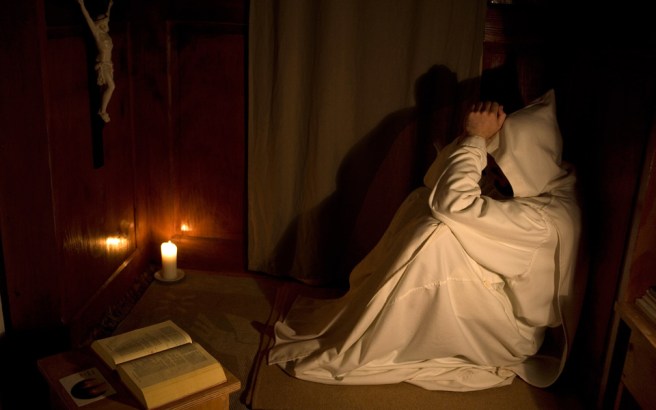 via dwightlockenecker.com
 via pinterest Debbie Cannon
 photo via Wikipedia
 pilgrimsofchrist.com